Buenos Aires
Speak so I can see you
Aizicovich /
Curator
Text by Laura Códega
Jun. 1, 2026 — Aug. 8, 2026
About exhibition
The prehistoric hands alluded to could well be the shadows of those belonging to the allegorical chained and dazzled slaves at the back of the cave.
In that case, we should think not only about how to understand the history of humanity through the history of fire, light, and electricity, but also through its shadows, its specters, its darkness.
There is no single history of humanity, and certainly no single way of approaching it through the history of electricity. To do so would require going back to interpretations as varied as those that link electricity to fire (a primordial element associated with the sun), to the moment when humans interpreted lightning as a celestial force, or to myths such as that of Prometheus, who stole fire from Olympus and, with it, the possibility of science and technology, only to be punished by being condemned to have an eagle devour his liver every day.
The relationship between electricity and divine energy is archaic and profound: Zeus hurled lightning bolts, Thor controlled storms, and Tláloc, Indra, and Jupiter were no less powerful. By the nineteenth century, electricity had come to occupy the symbolic place of a dangerous substance that externalized the human nervous system across the planet. In Frankenstein, Mary Shelley channels the imaginary of her time into the possibility of electrical energy animating dead matter.
It is evident that humanity cannot be conceived without its structural symbiosis with this invisible force, and the closest way to understand it is to observe its civilizational effects. As early as the 1960s, the great media theorist Marshall McLuhan, in books such as Understanding Media, saw the incorporation of electricity into everyday life as the great perceptual shock that followed the advent of print. What he innocently called the “global village” radically transformed human sensibility, the perception of time and space, and forms of social organization, leading toward what is now perceived as a synapse between media architectures, warfare, and information engineering.
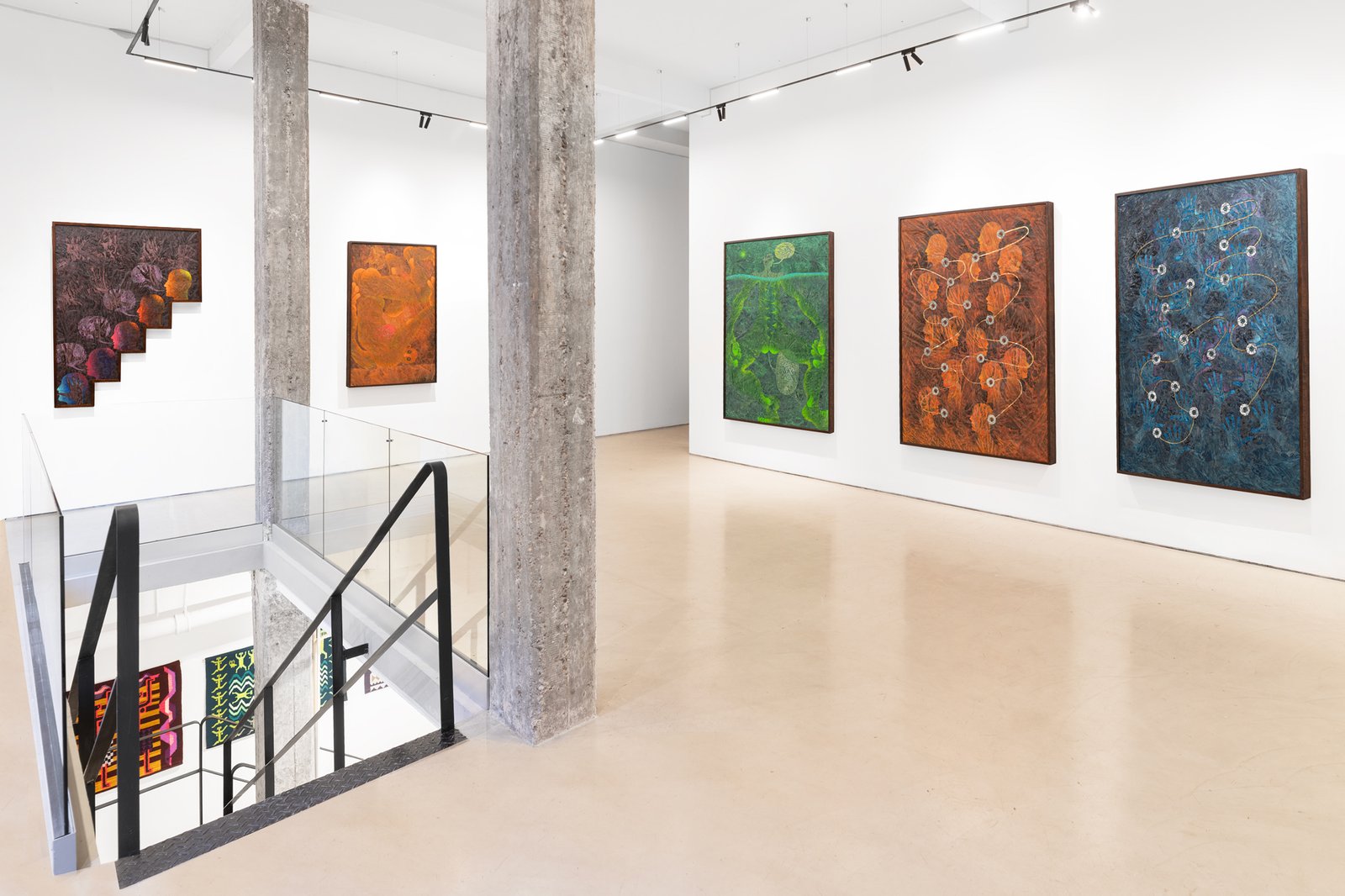
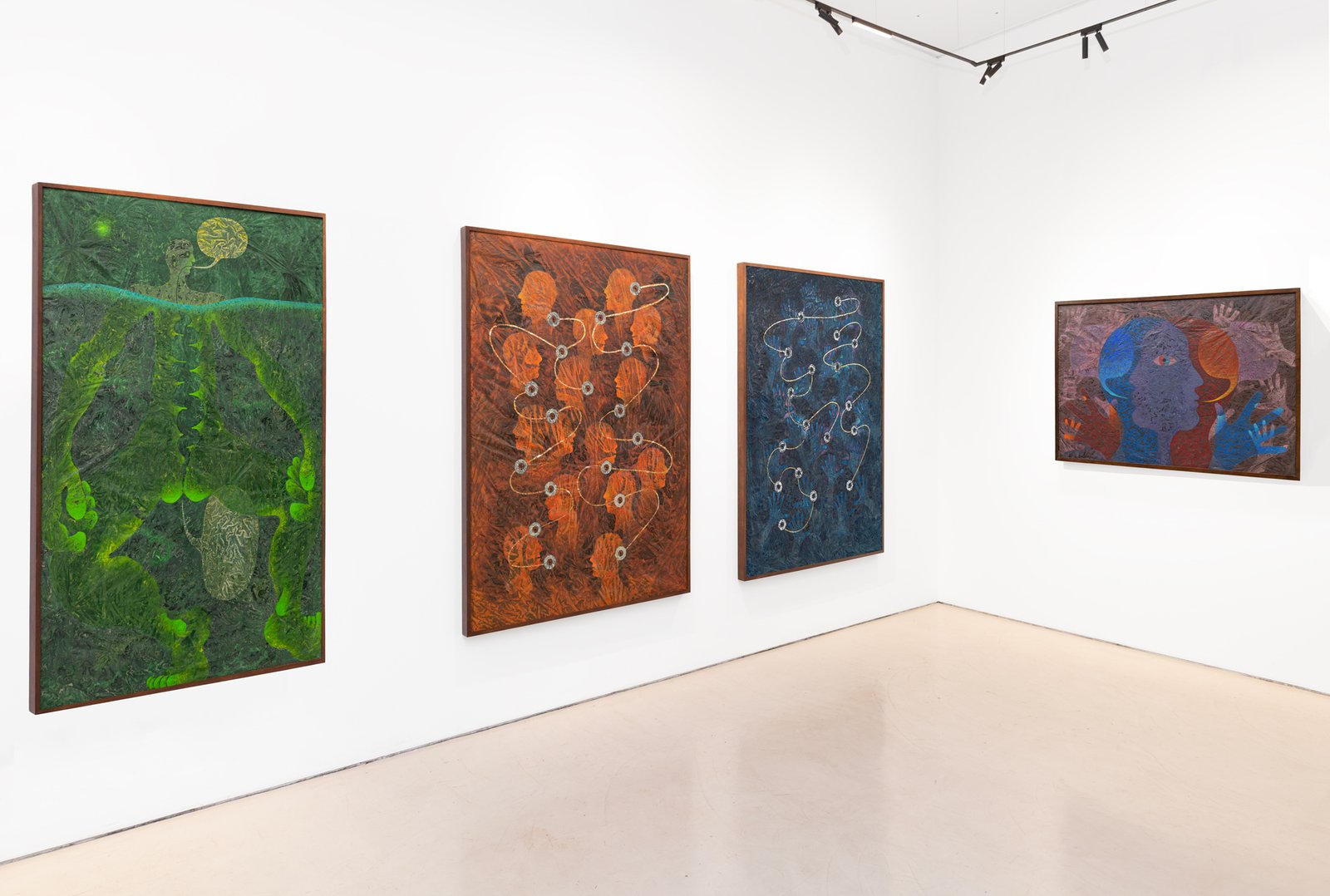
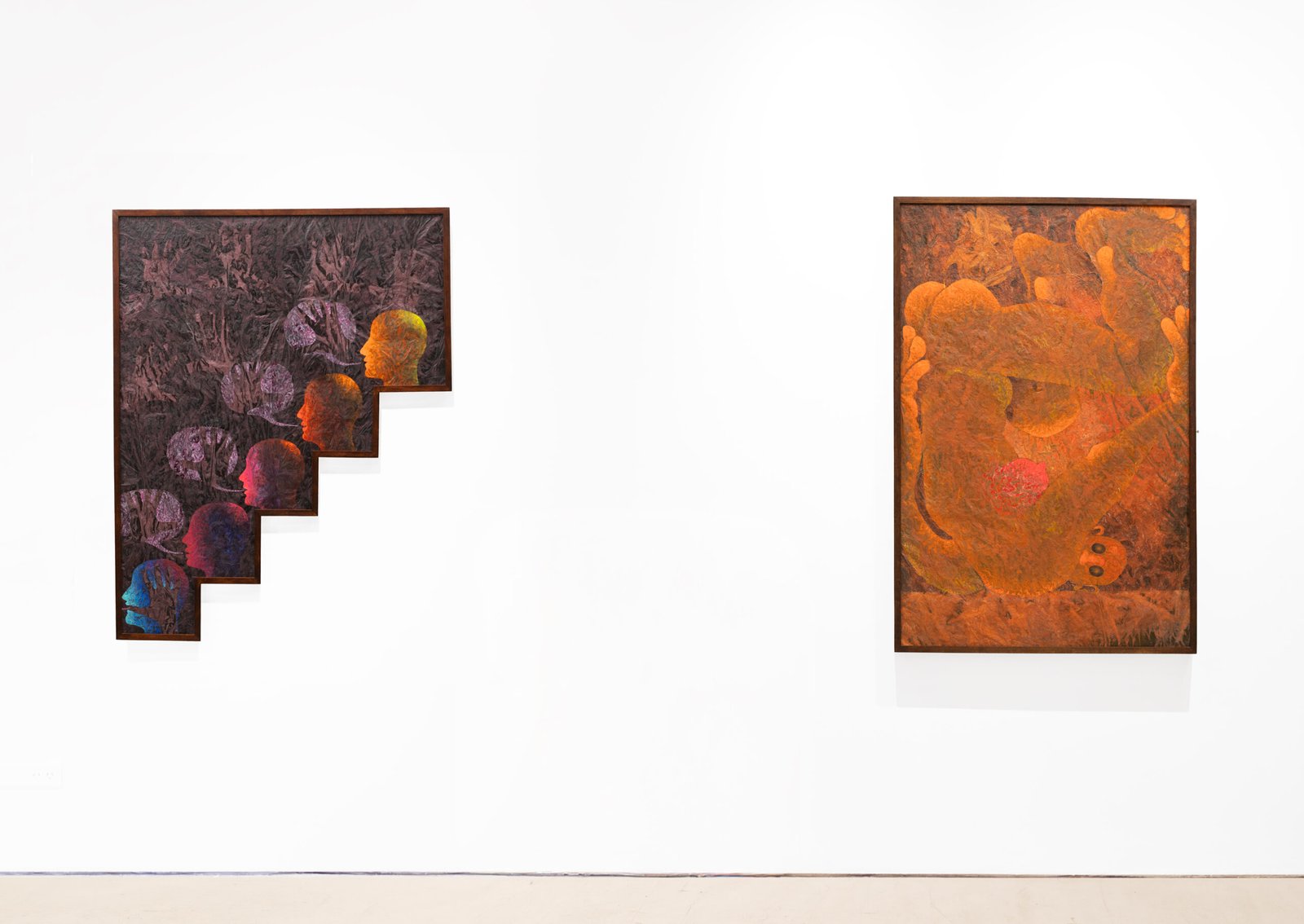
In this exhibition, Andrés Aizicovich presents a series of paintings made in oil and acrylic on paper that could be described as a collection of human profiles facing one another, aligned or arranged in tiers—some of them emitting empty speech bubbles—situated within a predominantly monochromatic floating space. In the background—or superimposed onto the figures—appear imprints of hands that evoke prehistoric cave paintings, and at times background and figure become reversible. Across this scene, a network of golden lines forms a closed system of circuits in which each nucleus, electrode, or node evokes unblinking eyes.
During the 1970s, the Spanish publishing house Salvat produced a striking collection of one hundred hardcover volumes devoted to the dissemination of history, science, and art: the Biblioteca Salvat de Grandes Temas. One of its volumes, titled CEREBRO Y CONDUCTA (BRAIN AND BEHAVIOR), featured on its cover the striking image of a child of approximately two years old with his head covered in electrodes. Although the term electrode—“path of electricity” in its Greek etymology—was first used in 1834 in the scientific journal Philosophical Transactions of the Royal Society in London, it was not until the development of electrotherapy and electrostimulation in modern medicine that the term gained wider circulation. Today, electrodes have become an interface between individuals, data, and control systems: they read the body, translate biological signals into digital information, amplify impulses so that they can be analyzed, and form part of the infrastructure of telephones, biometric surveillance, artificial intelligence, medical devices, brain-machine interfaces, data economies, and algorithms that interpret human behavior.
Returning to Aizicovich’s works, it is worth observing that the network of panoptic electrodes he depicts does not occupy the same conceptual space as the hands and profiles, but instead appears superimposed upon them, as though it were a synthetic interpretation of what lies behind them.
A Uranian bolt of lightning traces a path from the depths of time toward the unknowable future. A bolt of lightning does not know where it will strike, because that is the nature of lightning. There are two forms of behavior: that of humanity enthralled by its own image, spreading its hands like a child; and that of those same hands closing into a fist to grasp a weapon. The latter, in its wake, detonates Little Boy—the code name given by the United States to the atomic bomb dropped on the Japanese city of Hiroshima on August 6, 1945.
The prehistoric hands alluded to could well be the shadows of those belonging to the allegorical chained and dazzled slaves at the back of the cave. And in that case, we should think not only about how to understand the history of humanity through the history of fire, light, and electricity, but also through its shadows, its specters, its darkness.
The title of the exhibition, Habla para que pueda verte (Speak so that I may see you), makes a direct reference to synesthesia, which could be defined as the exchange of the function of one sense for another. In this case, replacing sight with speech. The human eye, which captures light and converts it into electrical signals that the brain interprets as vision, is urged to respond to the verb. Are these failed negotiations, superfluous dialogues, responses to absent questions? What do the empty speech bubbles that Aizicovich presents in his paintings refer to? Is this an ideological, pathological, and epochal muteness to which we have condemned ourselves as a species in this time dominated by the evil eye?
The phrase can also sound like an updating of the fundamental proposition “I think, therefore I am,” in which Aizicovich replaces think with speak. His message is an invitation to master the fall of lightning through language, and in this he has faith.
Two speaking humanoids, in positions that could be associated with fetal and birthing postures, have recovered their bodies. Judging by their exposed organs, they are capable of feeling. But the recipe remains elusive, and consciousness, that ancient spark, waits to speak, and, like a verdict, to utter its first and final word.
Nikola Tesla occupies the place of a modern sorcerer.

Aizicovich /
Unchained Melody
Pocetti /
Cured of fright
Renata Juncadella / Verónica Gómez /
Bringing the edges of the night
Canevari /
Force majeure
PECCI CAROU /
The Vigil of Eros
LEVY /
Third Spectral Atomic
PAREDES /
A handful of earth
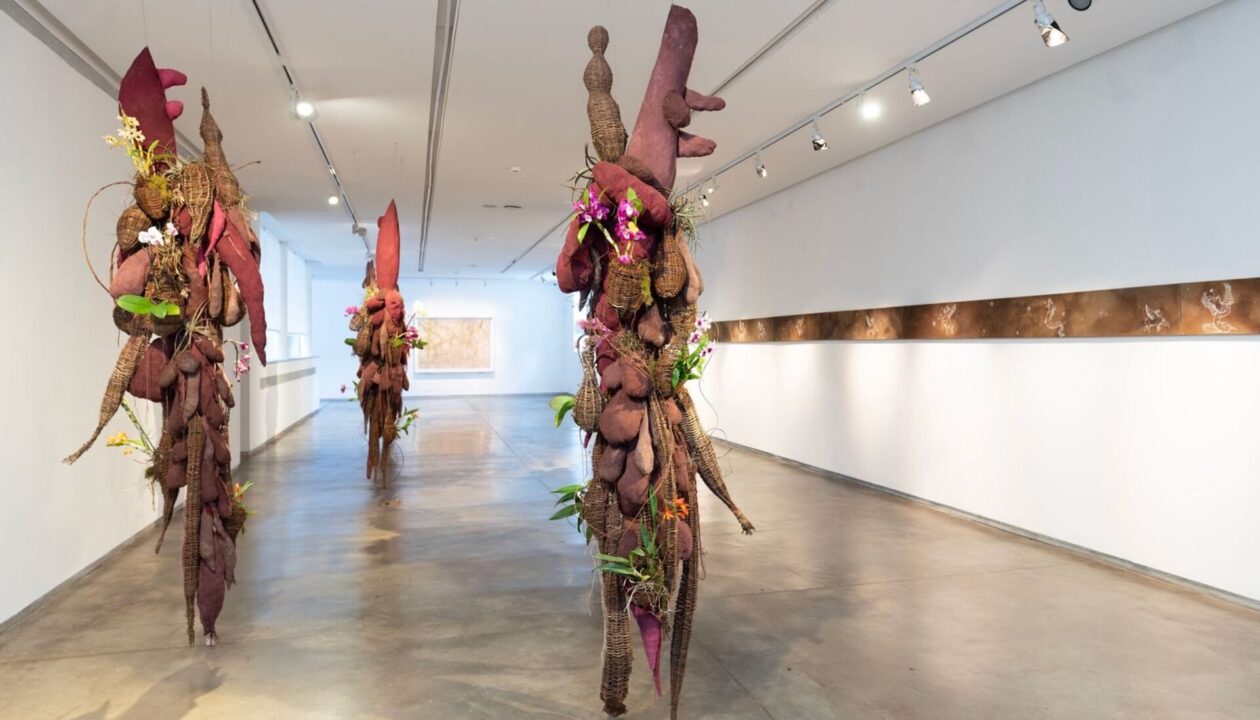
JUNCADELLA /
What cuts is a shortcut
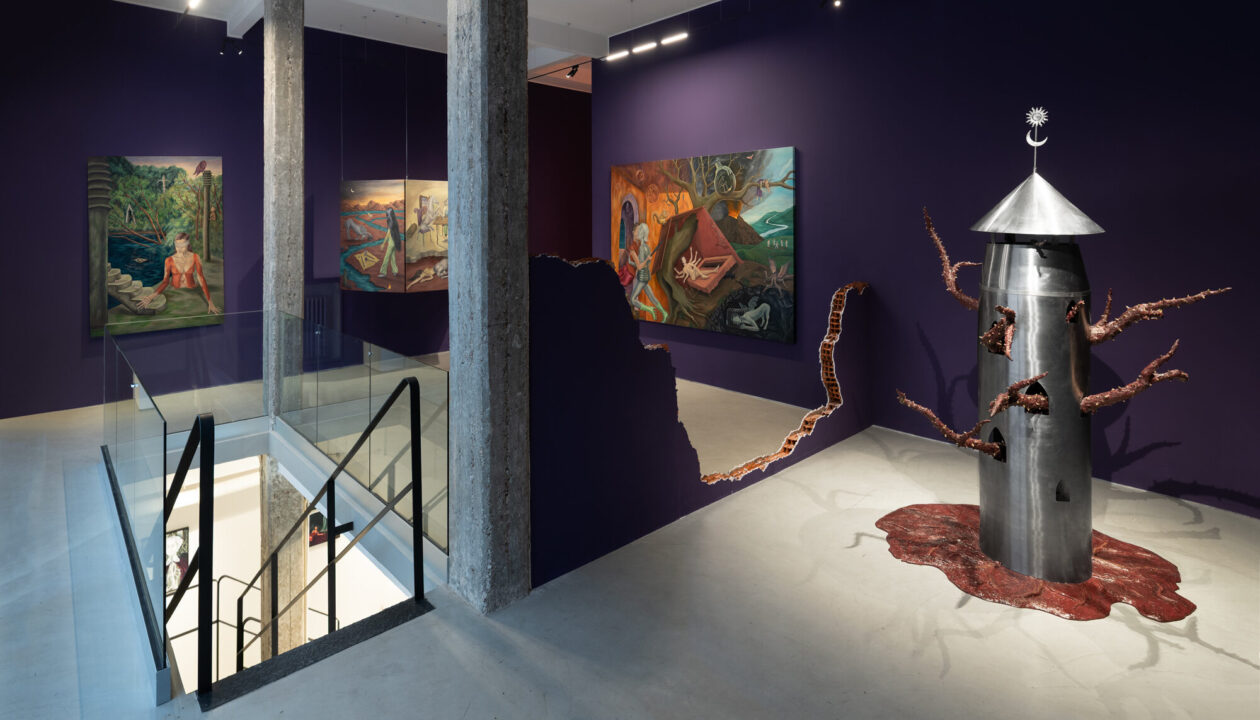
GIMÉNEZ /
Shell for something immense
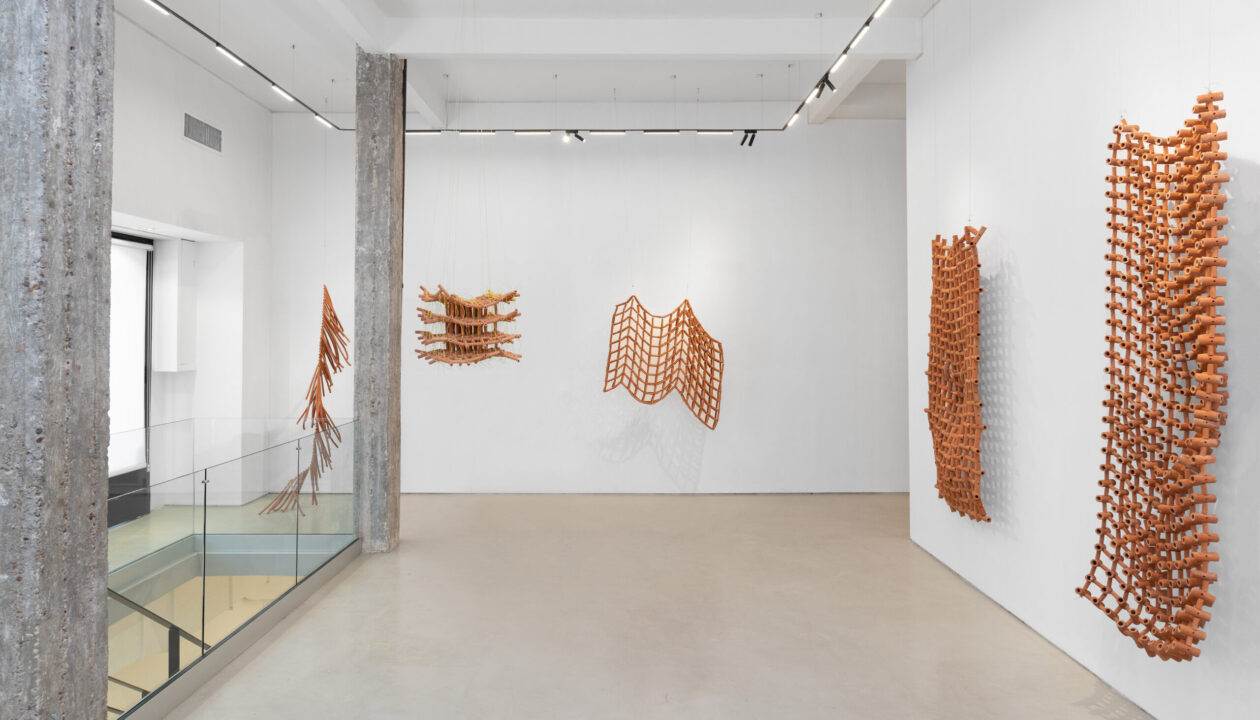
CALFAT /
Principle of innerness

PAREDES /
El jardín interior

VALENTINI /
La frontera fantasma

GRADÍN /
Genealogía Vegetal

GÓMEZ /
Las vestiduras peligrosas