Buenos Aires
The Vigil of Eros
PECCI CAROU /
Curator
Andrea Giunta & Danila Desireé Nieto
Nov. 27, 2025 — Mar. 7, 2026
About exhibition
What happens to love in times when cruelty seems to prevail?
We inhabit a convulsive present in which social sensitivity becomes plunder: specialists in emotional manipulation proliferate, along with disinformation campaigns that operate through bots to sell services to politics. At the same time, a new vocabulary floods the language that mediates social relationships—encounters, desire, the pursuit of a fleeting closeness or a lasting love. In this uncertain landscape, affects are set in motion.
Tinder, OkCupid, Bumble, Grindr are some of the virtual spaces where the first encounter takes place. These dating apps introduced an Anglophone glossary that replaced local slang: ghosting, match, swipe. It is striking that Argentine love relationships have adopted a vocabulary that leaves behind words such as chapar, apretar, tranzar, berretín, calentar. Now the emoji seduces and ghosting disappoints. Without epidermis, “touch parties” proliferate as an attempt to recover the body. But we ask ourselves: where do affects remain? Can falling in love be born in this economy of permanent availability?
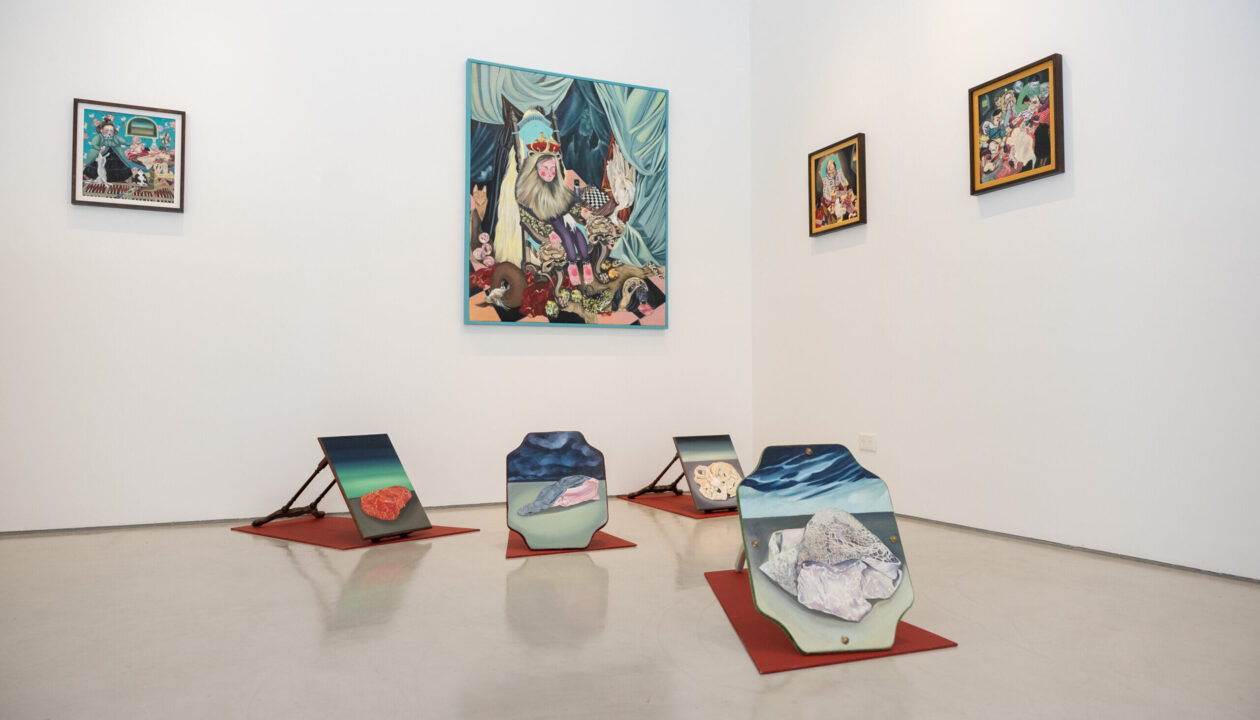
Fátima Pecci Carou proposes an emotional ethnography of experiences that exceed the autobiographical and cut across generations. The forms of encounter and love have transformed alongside their technologies: in her paintings, the artist works with plastic matter to explore the exciting and frustrating universe of new—and persistent—modes of eroticism, love, and disappointment. We love, we wait, we suffer; nothing new, yet profoundly different. Because networks devastate where neurosis strikes.
Since the appearance of the “like” in 2010—an overinterpreted minimal gesture—the rules of real bonds have been disrupted, producing daydreams and recurring nightmares. At the same time, the rise of the feminist tide of Ni Una Menos in 2015 installed a critical revision and renegotiation of sex-affective relationships. Monogamy, the heterosexual family, the stable couple explode, and pacts, consent, care, and the redistribution of responsibilities are debated politically. Sex becomes a link of power, a territory where times, agencies, limits, and desires are contested.
Along a life journey, and in parallel with these epochal transformations, Fátima moved from the trajectory of the traditional family to the fear of loneliness, digital dating, and a life of encounters via apps. Now the swipe unfolds people into her life like an infinite supermarket: it catalogs, orders, discards. In this hyperabundance, everything seems replaceable. In apps, intense and ideal exchanges are forged—affective fictions that collapse upon contact with the real. Even without reaching an in-person meeting, bonds are sustained in the digital universe; they stretch and fade without protocols. But the veil falls: ghosting—to disappear, to be erased.
Is looking for a partner like looking for an apartment or a job? Has finding love become an occupation? asks Alexandra Cohen. As in competitions, do we have to wait to be chosen? Is our only option to exist in the liquid market of screens? How do we construct ourselves, how do we deconstruct ourselves? Feminism produced certainties, but feminists also suffer. When we are ghosted, how do we trust again? Vulnerability generates doubt and anxiety. Will we keep having sex? Can we form a family from casual dating? Do stable bonds still exist?
Fátima’s works, read as a narrative, could follow the times of love and heartbreak and generate more questions than certainties: expectation, imagination, swiping, isolation, the pleasure of one’s own time, falling in love and disappointment, sex and fury, care and subordination, sadness and overflow. In her paintings, binarisms and linear narratives explode; bodies and kisses mix, fragment, and recombine. Affects are translated into pictorial language. Blurred images imprint a dreamlike timbre that summons fantasy and memory (echoes of Chinese porcelain, sinking into a sofa, the distant closeness of an elevator).
In images processed by artificial intelligence, manga and anime sediment, but the painterly condition interferes with illustration. At times nebulous, these representations invoke memories of encounters and missed encounters. Depersonalized faces evoke the screen and the algorithm that set the pace, mediate, serialize, and fragment. How do we construct our affects and our memories? Fátima’s paintings activate as mirrors of emotions in which we recognize ourselves. One area of the exhibition plunges us into the friction of naked bodies. The ceramics intensify the intimate, giving volume to caress, drive, and the vulnerability of closeness. Hands model as the brushstroke caresses the surfaces of the canvases. Episodes of social surveillance over “proper” demonstrations of affection also resonate: in 2019, a kiss between women in Constitución ended in detention.
How does fantasy function in times of hatred and arbitrary cruelty? How is eroticism activated in the continuous negotiation among fears, self-affirmation, and power tensions? In the culture of networks, are women positioned as colonized and lacking subjects, besieged by guilt and the threat of loneliness? Or have these feelings become generalized, crossing all identities and all forms of relating? Is it possible to build fair relationships within the logics imposed by platforms? Can we recognize ourselves as autonomous feminist subjects in scenarios where everything is measured, displayed, and replaced?
Feminism blocked the model of sacrifice, but individualism seems to have triumphed. Must we avoid crushes, falling in love? Networks produce emotional fatigue, states of heterofatalism and heteropessimism, argues Tamara Tenembaum. The sexual freedom championed by the feminist agenda of the 1960s and 1970s has become functional to the market. Contemporary love has installed a regime of uncertainty, maintains Eva Illouz. Against the mandate of availability, resistances emerge: single, volcel, autonomous practices, ways of withdrawing from the noise.
It is not surprising that nuns are in vogue. Faced with exposure and vulnerability in relationships, we can withdraw from the world of passions. In their apparent retreat, these women sought autonomy. They evaded rules, lived without husbands or children, wrote in a room of their own, thought, and elaborated other sexualities. From the convent wisdom in Las hijas de Felipe to the adventures of the Lieutenant Nun by Gabriela Cabezón Cámara, or the pop-holiness of Rosalía in Lux, mysticism, irony, and monastic empowerment coexist. “Know how to disappear. When you come is when I leave,” sings the Catalan in Berghain. Even Moria Casán contributes her pedagogy of autonomous pleasure. Can mysticism respond to the weariness of a capitalist and patriarchal world that commodifies bodies and affects, or is it merely another fantasy to escape the mandate of hyperconnection?
Fátima’s blog (https://fatimapeccicarou.com/El-trabajo-de-buscar-ser-elegida) functions as a refuge, but also as a laboratory of emotional thought, an intermediate field between artwork, diary, and manifesto. A territory from which to launch many of these specific questions that stalk and keep her awake. That stalk and keep us awake. An affective, feminist writing in which art, eroticism, and politics intersect.
But in this case we are dealing primarily with paintings; with all that the insistence of the act of painting entails—caressing the surface of the canvas with hair and color, diluting limits, leaving the trace of pigment moisture in superimpositions that fuse with each brushstroke. Painting veils and unveils. Covers and reveals. Perhaps there is no more sensual, more precise, and more fitting way to formulate the questions with which Eros pierces us today, in his enchanting, insistent, and mischievous aim.
Andrea Giunta and Danila Desireé Nieto
Buenos Aires, November 27, 2025

Selected works

JUNCADELLA /
What cuts is a shortcut

PAREDES /
A handful of earth
LEVY /
Third Spectral Atomic
GIMÉNEZ /
Shell for something immense
CALFAT /
Principle of innerness

PAREDES /
El jardín interior

VALENTINI /
La frontera fantasma

GRADÍN /
Genealogía Vegetal

GÓMEZ /
Las vestiduras peligrosas